
Why Your Low Back Feels Tight (and How to Finally Fix It from the Inside Out)
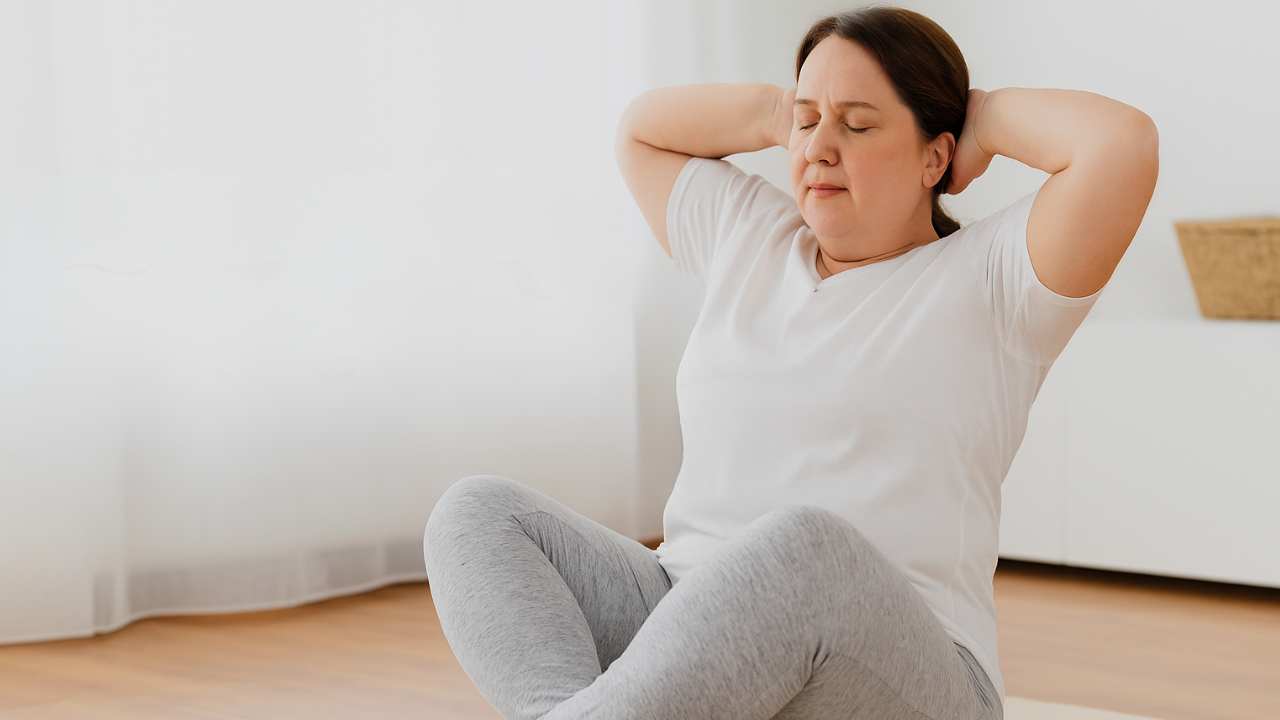
If you’ve ever bent forward or turned too quickly and felt your low back grab, you know the feeling — that deep, protective tension that doesn’t want to let go.
I had my most recent reminder of it in a haunted corn maze, of all places. Someone jumped out from behind a hay bale and scared the hell out of me. My whole body jolted, and my low back tweaked.
That kind of moment isn’t just about muscle strain. It’s your nervous system bracing against a perceived threat.
The brain sends a “protect” signal, the muscles tighten, and suddenly your back feels locked and sore.
This protective tension isn’t bad — it’s intelligent. But when it becomes chronic, it traps us in a loop of overprotection and discomfort.
The good news: there’s a way to unwind that pattern.
What muscles are supposed to support my spine (and why they stop doing their job)?
Your low back isn’t meant to work alone. It’s part of a support team that includes the glutes, transverse abdominals, hip flexors, and obliques — muscles that share the job of stabilizing your spine and pelvis.
But when we sit too much, move inconsistently, or over-rely on one area (often the low back), that balance falls apart.
How imbalance happens
When one muscle group “checks out,” another steps in to help.
Over time, the low back becomes the overachiever — doing its job and everyone else’s.
That’s when tension, fatigue, and pain begin to show up.
It’s not weakness. It’s compensation.
What are the obliques — and how do they actually support your low back?
The obliques — sometimes called your “side abs” — are the broad, diagonal muscles that wrap around your waist, connecting your ribs to your pelvis.
You have two layers:
-
The external obliques, which run downward and inward (like sliding your hands into your pockets).
-
The internal obliques, which run upward and inward — the opposite direction.
Together, they create a woven, crisscross support system that stabilizes your spine and keeps your ribs and pelvis working together as you twist, bend, and breathe.
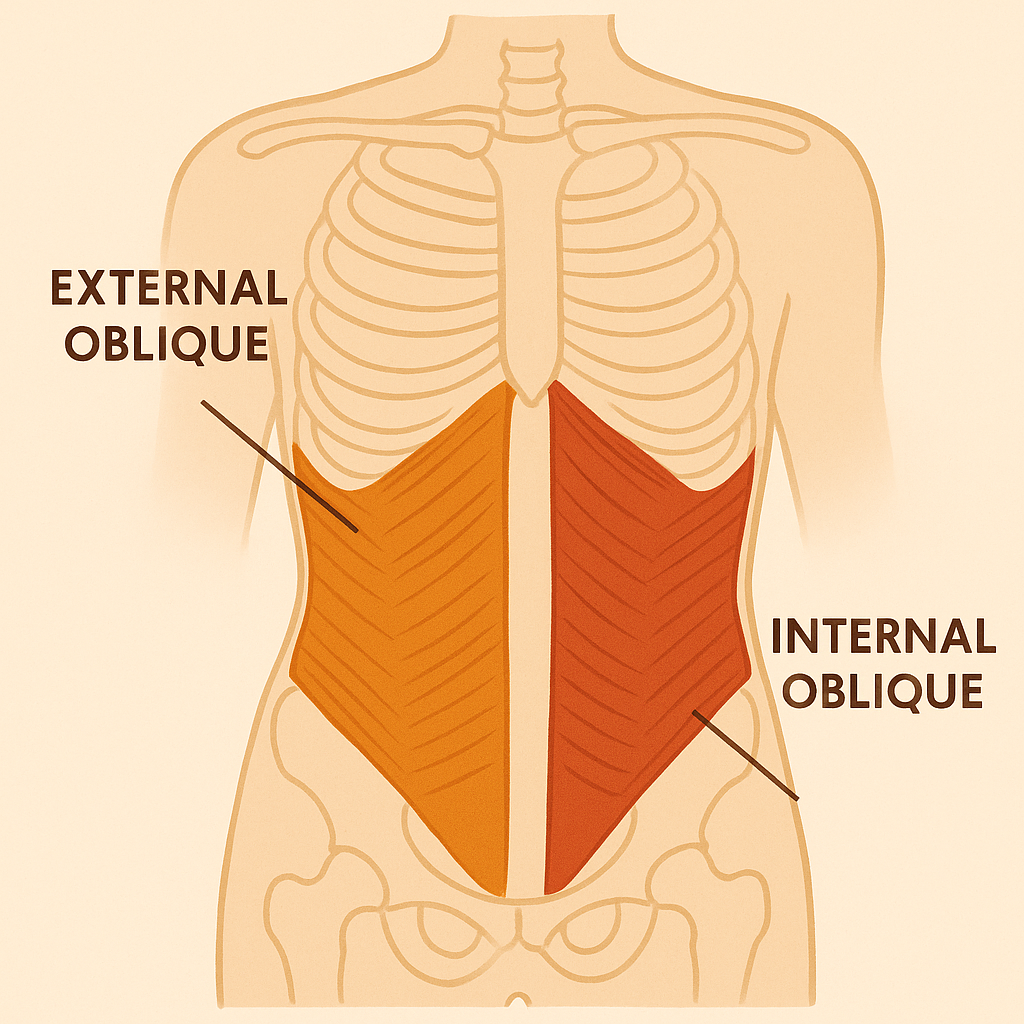
Think of your obliques as your body’s built-in corset — not rigid, but dynamic. They hold everything in conversation, balancing strength and flexibility so your spine doesn’t have to grip so hard.
The magnet analogy
Imagine your ribs and pelvis as two metal plates. Your obliques are the magnets that draw them gently toward each other. When the magnets are “on,” your torso feels unified — strong but supple. When they’re “off,” the connection drifts, and your low back ends up carrying the load.
How do I know if my core isn’t engaging properly?
If you notice any of these patterns, your obliques might be offline:
-
Your low back always feels tight, especially after standing or sitting for a long time.
-
You feel unstable or “disconnected” when twisting or reaching.
-
You can’t seem to “find” your core, no matter how many planks you do.
-
You hold your breath when you move.
How to feel your side abs (the easy way)
Place your hands on the sides of your waist, between your ribs and hips.
Now cough.
That tightening under your hands? That’s your obliques switching on.
A few gentle ways to reconnect
-
Seated Side Bend – Sit tall, feet grounded. Reach one arm overhead and lean to the opposite side. Feel the stretch and subtle contraction at your waist.
-
Supine Knee Drop – Lie on your back, knees bent. Let both knees drop slightly to one side, then return to center. Feel the side of your waist engage to pull you back.
-
Breath Awareness – Place your hands around your ribcage. As you inhale, feel expansion in every direction — not just the front. As you exhale, notice how your sides gently hug inward. That’s your obliques helping your breath.
Can yoga really help my low back and core strength?
Absolutely — when it’s done intelligently.
In my classes, we always start by waking up the muscles that support the spine:
-
Glutes – your power base.
-
Transverse abdominals – your deep, corset-like stabilizers.
-
Hip flexors – your misunderstood helpers that need retraining, not punishment.
-
Obliques – the connectors that integrate it all.
Once this foundation is active, we move into twisting, side-bending, and stabilizing sequences that retrain the body to share the workload evenly.
Slow, intentional movement builds coordination and safety — not just strength.
It helps the brain trust movement again.
How can I start retraining my body to move this way?
This week’s class, Magnetic Obliques, is built exactly for this. It’s beginner-friendly but deeply effective — a way to feel your side body wake up and support your spine in real time.
We’ll start with the glutes, transverse abs, and hip flexors because support always comes before challenge. Then we’ll bring the obliques into the conversation with controlled, mindful movement.
Both Oli and I broke a sweat filming it, so whether you’re rebuilding strength or looking for refinement, you’ll find your edge.
By the end, you’ll not only know where your obliques are — you’ll feel them: responsive, alive, and in sync with your low back.
How can I try this for free?
You can take Magnetic Obliques inside Yoga In Your Living Room online studio with a 14-day free trial, no credit card or cancellation required.
You’ll get access to hundreds of classes designed for real bodies — classes that teach you to move with clarity, curiosity, and consistency.
Because movement isn’t about working out.
It’s about keeping your body working.
👉 Start your free 14-day trial today
Meet your guide

